
Παρουσίαση/Προβολή
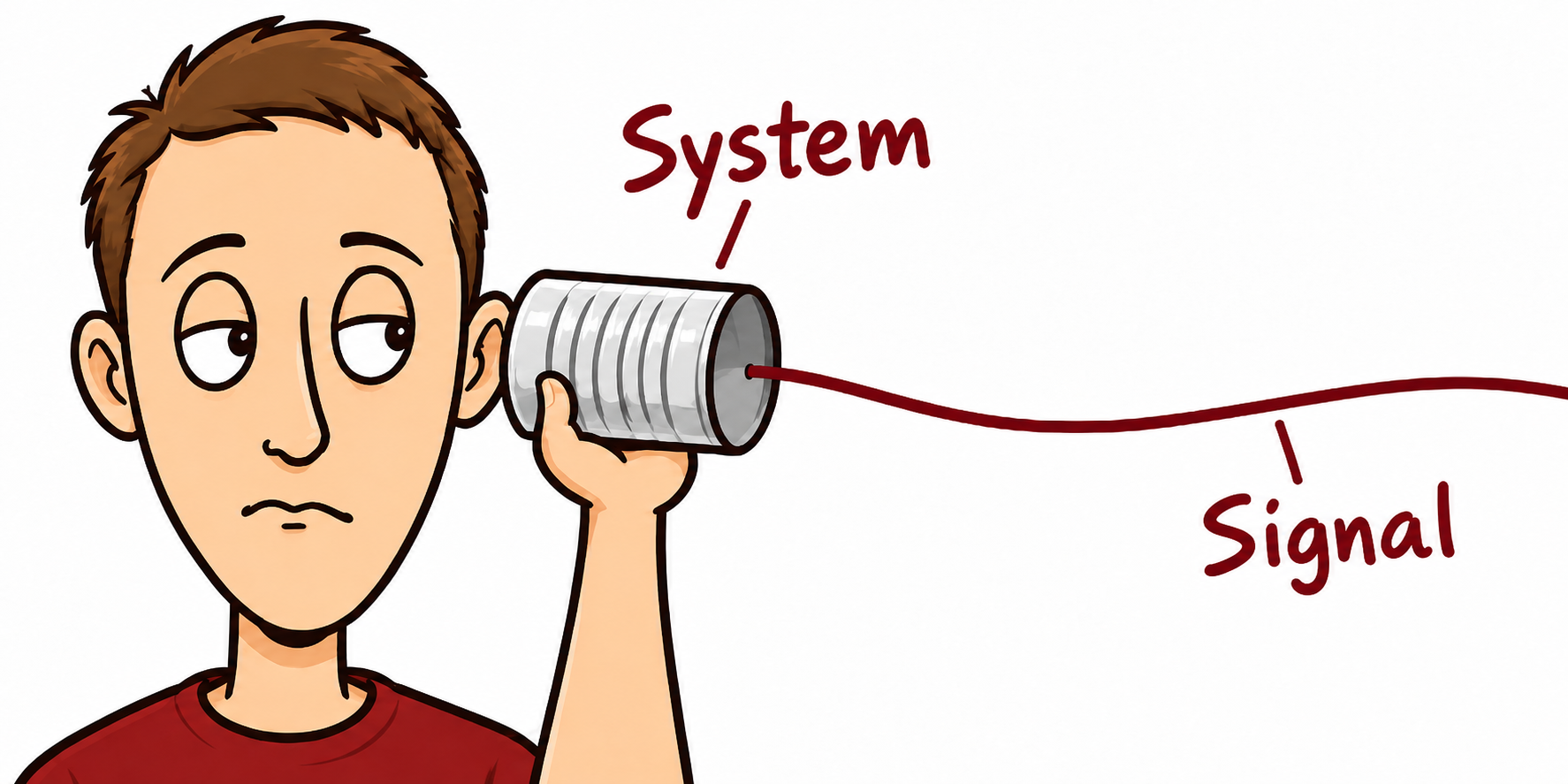
(ECE_K340) - Michael Paraskevas, Nikos Spatiotis, Michael Nanos
Περιγραφή Μαθήματος
Definition, categories, characteristic parameters, and properties of continuous-time signals and continuous-time systems. Input-output relationship of a system. The convolution integral, its properties and methods of calculation. Fourier series. Fourier transform and its properties. Autocorrelation and convolution properties. The Parseval theorem. Power spectral density. System frequency response. Ideal and real filters. Autocorrelation function. Laplace transform and region of convergence (ROC). Properties and theorems of the Laplace transform. Relationship between the Fourier and Laplace transforms. Analysis of linear systems using the Laplace transform. System transfer function.
Keywords: Continuous-time signals, continuous-time systems, study of LTI systems, convolution, Fourier analysis (series and transform), Laplace transform, frequency response, transfer function, analogue filters.
UNIT 01 – Introduction to Continuous-Time Signals
Objectives of Signal Processing, Classification of signals in terms of time and amplitude, Characteristic parameters of signals, Classification of signals in terms of energy and power, Transforms of the independent variable, Categories of continuous-time signals.
UNIT 02 – Elementary Continuous-Time Signals
Unit step function, Impulse function or delta function, Representation of signals using the delta function, Unit ramp, Exponential signals (real and complex), Sinusoidal signals, Pulses (square and triangular), Sampling function, Train of impulse functions (Comb signal).
UNIT 03 – Introduction to Continuous-Time Systems
Definition and categories of systems (Continuous-time systems, Discrete-time systems), System interconnections, Types of systems (Linear and non-linear systems, causal and non-causal systems, static and dynamic systems, time-invariant and time-varying systems, stable and unstable systems).
UNIT 04 – Study of Linear and Time-Invariant Systems
Description of Linear and Time-Invariant (LTI) systems using ordinary differential equations or using the convolution integral, The impulse response of LTI systems, The Convolution Integral in LTI Systems, Properties of Convolution (Commutative Property, Associative Property, Distributive Property, Identity Property, Homogeneity Property, Bandwidth Property).
UNIT 05 – Methods for Calculating the Convolutional Integral
Analytical calculation of the convolution integral, Graphical method for calculating the convolution integral, Convolutions of known continuous-time signals, Step response of a system, System response to an exponential complex input, LTI system configurations.
UNIT 06 – Laplace Transform
Eigenvalues of a system, Mathematical definition of the Laplace transform, The region of convergence of the Laplace transform, Poles and zeros of the Laplace transform, Useful pairs of Laplace transforms.
UNIT 07 – Properties of the Laplace transform – The inverse Laplace transform
Properties of the Laplace transform, Symmetries of the Laplace transform, Convolution theorems in time and frequency, Initial and final value theorems, Calculation of the inverse Laplace transform (simple fraction expansion method, Heaviside’s method, terms with exponential delay).
UNIT 08 – Signal Analysis using the Fourier Series
Revision of natural frequencies, Conditions for the existence of a Fourier series, Expansion of a signal into a Fourier series (Exponential form, Trigonometric Form A, Trigonometric Form B), Normalised power of the Fourier series, Parseval’s theorem for periodic functions, Gibbs’ phenomenon, Relationship between the Fourier series and the Fourier transform.
UNIT 09 – Fourier Transform
Definition of the Fourier transform, Physical significance of the Fourier transform, Conditions for the existence of the Fourier transform, Relationship between the Fourier and Laplace transforms, Properties of the Fourier transform, Parseval’s theorem, Useful pairs of Fourier transforms.
UNIT 10 – Inverse Fourier transform – Fourier transform of power signals
Inverse Fourier transform, Fourier transform of power signals, Correlations and Spectral Densities, Autocorrelation Function, Cross-correlation Function.
UNIT 11 – Analysis of LTI Systems using the Laplace Transform
Solving Linear Differential Equations using the Laplace Transform, System Transfer Function, Stability and Causality Analysis of Systems in the Frequency Domain, System Couplings in the Frequency Domain, Step Response of a LTI System, Description of Systems in State Space.
UNIT 12 – Study of LTI Systems using the Fourier Transform
Frequency Response of an LTI System, Amplitude and phase representation of the frequency response, System LTI Response to a Periodic Input, System LTI Response to a Non-Periodic Input, Description of a Linear Differential Equation using the Fourier Transform, Inverse Systems.
UNIT 13 – Linear Filters
Ideal Linear Frequency-Selective Filters (Ideal Low-Pass Filter, Ideal High-Pass Filter, Ideal Band-Pass Filter, Ideal Band-Reject Filter), Characteristic properties of ideal filters, Filter Bandwidth, Practical Filters, Prototype Low-Pass Analogue Filters.
Ημερομηνία δημιουργίας
Δευτέρα 12 Οκτωβρίου 2026
-
Δεν υπάρχει περίγραμμα